Tag Archives: Christianity

Habemus Papam!

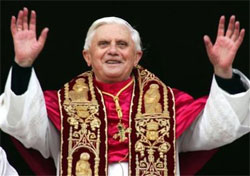
AP photo of Pope BenedictPrior to becoming Pope Benedict XVI, Carninal Joseph Ratzinger said the following in a homily.

"Having a clear faith, based on the creed of the church, is often labeled today as a fundamentalism. Whereas relativism, which is letting oneself be tossed and ‘swept along by every wind of teaching,’ looks like the only attitude acceptable to today’s standards."

"We are moving toward a dictatorship of relativism which does not recognize anything as for certain and which has as its highest goal one’s own ego and one’s own desires."

Compare this to John Paul II’s 1993 encyclical Veritatis Splendor (101).

"In the political sphere, it must be noted that truthfulness in the relations between those governing and those governed, openness in public administration, impartiality in the service of the body politic, respect for the rights of political adversaries, safeguarding the rights of the accused against summary trials and convictions, the just and honest use of public funds, the rejection of equivocal or illicit means in order to gain, preserve or increase power at any cost – all these are principles which are primarily rooted in, and in fact derive their singular urgency from, the transcendent value of the person and the objective moral demands of the functioning of States. When these principles are not observed, the very basis of political coexistence is weakened and the life of society itself is gradually jeopardized, threatened and doomed to decay (cf. Ps 14:3-4; Rev 18:2-3, 9-24). Today, when many countries have seen the fall of ideologies which bound politics to a totalitarian conception of the world – Marxism being the foremost of these – there is no less grave a danger that the fundamental rights of the human person will be denied and that the religious yearnings which arise in the heart of every human being will be absorbed once again into politics. This is the risk of an alliance between democracy and ethical relativism, which would remove any sure moral reference point from political and social life, and on a deeper level make the acknowledgement of truth impossible. Indeed, ‘if there is no ultimate truth to guide and direct political activity, then ideas and convictions can easily be manipulated for reasons of power. As history demonstrates, a democracy without values easily turns into open or thinly disguised totalitarianism’"

"Thus, in every sphere of personal, family, social and political life, morality – founded upon truth and open in truth to authentic freedom – renders a primordial, indispensable and immensely valuable service not only for the individual person and his growth in the good, but also for society and its genuine development."

As William Donahue said, "The Catholic League is delighted. Those who are not need to do some real soul searching.". Amen. Long live the pope!

My 15 Nanoseconds of Fame

Some of you may recall that I mentioned an interview I would be taking part in. Well, it’s now available for all to listen. 🙂 On April 11, Mike Woycek of Pittsburgh Webloggers (and Grabass) interviewed me and Rob of Unspace. We talked about two prominent deaths in the news, Pope John Paul II and Terri Schiavo. I’m not thrilled with the sound of my voice and I’m not sure I’m cut out for on-the-fly apologetics, but it was a pleasant experience on the whole. Mike and Rob seem like great guys and I hope to interact more with them in the near future.

What are you still doing here? Go listen to me pontificate. 😉

Update: Rob has a superb explanation of the whole experience, from soup to nuts. Rather than reinvent the wheel and write one of my own, I’ll just suggest you read Rob’s account. His blog is worth a read anyhow. 😉 On a side note, don’t let him fool you – he can certainly hold his own in a discussion/debate. Just wait until you hear my arguments get eviscerated by him in the Terri Schiavo segment. 😉

Update: Part 2 can be found here.

Aged Like a Fine Wine or Spoiled Like Old Milk?

Sean, an agnostic friend of mine asked me to post the following multi-part question.

"How old does something have to be to be considered traditional/conservative?"

"Abraham Lincoln is considered a conservative because he wanted to preserve the Union as it had been for the first 75 years of our country. To me 75 years (which also is about 1 lifetime) makes a good rule of thumb. When something has been around 75 years, virtually no one alive has ever experienced life without it, whatever it is."

"More food for thought:
Watching football on thanksgiving is considered a tradition, but television has only been around for 50 or so years. Christianity is generally thought of as conservative, but 2000 years ago it was a radical idea. So again I ask, how old does something have to be to be considered conservative?"

It’s an interesting question and one worth answering well. My only quibble would be the equation of "traditional" to "conservative". Within the context of Christianity, particularly Catholicism, tradition often correlates poorly with the political spectrum. A better choice would be orthodox versus progressive. However, even those are dificult to apply broadly because different groups define each differently and will not always consider them mutually exclusive. That, in my opinion, is one of the greatest strengths of the Catholic Church. Right or wrong, for better or for worse, whatever the Church deems official teaching is ground truth for orthodoxy, like it or not.

So what do you folks think?

Treacherous Tongue?

Rand of A Form of Sound Words says:

"DARN it to HECK! I can’t believe Billy believes that load of CRAP. I mean JEEEZ, what is he thinking. I tried and tried to talk some sense into him, but OH MY GOSH, he’s stubborn."

"I apologize in advance to all the good and faithful Christians reading the above phrases and are offended. Your reaction is appropriate. I still felt it was important for me to post it as an example. You see, in the above four little phrases, we have a remarkable four blasphemies, and one gross word that any civil human would avoid using (non-Christian’s included)"

Which word? "Thinking"?

"Puritanism: The haunting fear that someone, somewhere, may be happy." – H. L. Mencken

Bye, Bye, Marty

June 22, 2005

I still get a number of hits to my post about the firing of Christian talk show host Marty Minto. I never quite finished it because I got tied up in more important things, so I decided to come back and do just that. For those interested, the original entry can be found in its entirety (misspellings, bad grammar, and all) here.

Continue reading